


Why the Internet Is Becoming More Personal and Less Public
The conversation that never appears in publicWhat follows is an illustrative scenario, not a documented event.On a weekday morning, a regional newspaper publish...
Community Author · November 6, 2026
The conversation that never appears in public
What follows is an illustrative scenario, not a documented event.
On a weekday morning, a regional newspaper publishes an investigation into a local hospital trust, and posts it to a large public social platform. The post gathers a respectable number of likes and reposts. Beneath it, a few dozen replies accumulate: some outrage, some jokes, a handful of people insisting the story is biased, a bot or two promoting something unrelated.
But that public thread is not where most of the meaningful conversation happens. A nurse screenshots the article and drops it into a group chat with former colleagues, where it prompts a long, frank exchange about what they saw working there. A parents' group on a messaging app shares the link with a question about whether the maternity unit is safe. A small invitation-only forum for health policy researchers debates the methodology. Two siblings forward it to each other with a single line about their late father's care. None of these exchanges is visible to the newspaper, to search engines or to the people replying publicly. Together, they are probably the most important response the story receives.
The public post was the spark; the conversation took place elsewhere. That distinction — between public visibility and actual social interaction — runs through one of the most significant and least measured changes in online life. A growing body of evidence suggests that much everyday sharing has moved from public feeds into private messages and smaller groups. Whether that means the internet as a whole is becoming less public is a harder question, and the honest answer is more complicated than either nostalgia or alarm would suggest.

The internet was never entirely public
A familiar story holds that the early internet was an open commons — a world of public forums, personal home pages and blogs where anyone could read anything — which was later enclosed by corporate platforms and is now retreating into private chats. The story contains some truth, but it gets the history wrong in an important way.
Private digital communication is as old as networked computing. Email predates the web by decades, and for most of the internet's history it has carried a far larger share of everyday communication than any public forum. Mailing lists, many of them closed to outsiders, were the backbone of academic, technical and hobbyist communities. Chat rooms and instant messaging — IRC channels, AOL chat, ICQ, AIM, MSN Messenger — were central to how a generation first experienced being online, and much of that activity was ephemeral and unarchived. Private groups on services from Yahoo! Groups to early Facebook were common. Meanwhile, public spaces — Usenet, web forums, personal websites, blogs — coexisted with them, and they too were often small, semi-closed in practice, and governed by local norms.
It is also worth remembering who was absent. The early internet's "public" was small, disproportionately affluent, Anglophone and technically literate. Its openness was real, but it was the openness of a small town square, not a global one. Many early forums were also hostile environments for women and minorities, which complicates any romantic picture of a lost golden age.
What may have changed, then, is not the existence of private communication but its balance with public broadcasting — and the infrastructure that mediates both. In the 2000s and 2010s, large social networks made it normal for ordinary people to publish to wide audiences by default. Status updates, photos and opinions that might once have been shared by email or in conversation were posted publicly or semi-publicly, visible to friends of friends and often to strangers. The question now is whether that period of mass public self-publishing was the norm or the exception.
The rise — and fatigue — of the algorithmic public square
The social networks that dominated the 2010s did more than host public conversation. They restructured it. Chronological timelines gave way to algorithmic feeds that rank content by predicted engagement and, increasingly, mix posts from followed accounts with recommendations from strangers. This changed the nature of public speech in several ways.
First, it altered the audience. The social media researchers Alice Marwick and danah boyd described the problem of context collapse: on social platforms, audiences that would normally be separate — family, colleagues, friends, strangers — are flattened into one, and speakers must manage how a single message will be read by all of them. Algorithmic distribution intensifies this, because a post can be shown to people the author never imagined, stripped of context and read in bad faith.
Second, it created incentives for performance. When visibility depends on engagement, content that provokes strong reactions travels further. Platforms do not publish complete details of their ranking systems, and the effects of particular design choices are contested in the research literature, but there is broad agreement that engagement-based ranking rewards attention-grabbing content and that public conversations on large platforms can quickly become adversarial.
Third, it made virality a risk as well as an opportunity. Ordinary users discovered that a post intended for a small circle could be amplified to millions, with consequences ranging from embarrassment to harassment.
The platforms themselves now describe a shift away from public sharing among ordinary users. In the US Federal Trade Commission's antitrust case against Meta, the company's own presentation at trial in April 2025 showed that the share of time people spent viewing content posted by friends had fallen over two years, to 17% on Facebook and 7% on Instagram. Mark Zuckerberg testified that friend-sharing on Facebook had been declining and that people increasingly discover content in feeds and then share it in private messages. Instagram's head, Adam Mosseri, has said repeatedly since 2022 that more photos and videos are shared in direct messages than in Stories, and more in Stories than in the main feed. These figures come from companies with strategic interests in how they are interpreted — Meta's trial argument depended on showing that it now competes with entertainment platforms — but they are consistent with each other and with the companies' product decisions.
The result is a division of labour: public feeds increasingly function as entertainment and discovery systems filled with professional and recommended content, while personal interaction moves into messages and groups.
Why smaller spaces can feel more human
Asked why they discuss news in messaging apps rather than on public platforms, participants in focus groups for the Reuters Institute's Digital News Report as long ago as 2018 described private groups as places where they could speak more freely and with less risk of confrontation. Adam Mosseri put the underlying logic simply: there are more things people feel comfortable saying to someone one-on-one than things they feel comfortable sharing publicly. Several mechanisms seem to be at work.
Trust and familiarity. In a group chat, people know who is listening. Their words will be read by people who know their history, tone and intentions. Repeated interaction builds shared context and makes reputational costs real: you will see these people again. Reduced performance pressure follows: there is no anonymous audience to impress or provoke. Shared interests give a reason for the group to exist and a frame for what is relevant. And belonging — the sense of being among one's own people — has psychological value that public platforms struggle to provide.
It is important, though, to separate very different kinds of "small" space. A close personal network — family chats, friendship groups, colleagues — is private in the ordinary social sense: its members already know each other. A semi-private community — a Discord server, a paid membership forum, a creator's community app, a professional Slack group — may contain hundreds or thousands of people who have never met, united by a shared interest or by payment. These spaces are smaller than public platforms, but they are not intimate, and their dynamics can resemble public ones.
Nor are smaller spaces automatically safer or healthier. Group chats can spread misinformation as easily as public feeds — the Reuters Institute and others have documented concerns about false information circulating on messaging apps in many countries — and because they are closed, misinformation in them is harder for outsiders to detect or correct. Small groups can enforce conformity, exclude dissenters and radicalise their members. Private does not mean secure either: a conversation can be private socially and still be stored, leaked, screenshotted or accessed by the platform. Privacy describes who is allowed to see a conversation; security describes whether that boundary actually holds.
The economics of digital intimacy
The movement towards smaller spaces is not only social. It is also an economic opportunity that creators, publishers and platforms have moved quickly to exploit.
The logic is straightforward. A large public following is valuable mainly through advertising or brand deals, and its value depends on reach that platforms control. A smaller, highly engaged community may be worth more per person, because its members are more likely to pay — for subscriptions, memberships, exclusive content, events or direct access. Newsletter platforms with paid tiers, membership tools for podcasts and video creators, and community software for paid groups all build on this premise. Professional networks and private Slack or Discord communities serve similar functions for industries and expertise-based groups.
The economics of direct audience relationships differ from those of public reach in important ways. Revenue can be more predictable when it comes from recurring subscriptions rather than fluctuating ad impressions. The creator or publisher typically holds the contact relationship — an email list, a membership database — rather than depending entirely on a platform's distribution. And members of a paid community may tolerate, or even prefer, a slower and more considered pace of interaction.
But these models are not universally sustainable, and the evidence on how many creators earn meaningful income from them is limited and often promotional. Paid communities depend on a continuing flow of value to members, which means continuous labour: community management — moderating discussions, welcoming newcomers, answering questions, resolving disputes, producing exclusive content — is time-consuming and often underestimated. Churn is a constant pressure. And the communities still run on platforms whose terms, fees and features can change. Digital intimacy can be a business, but it is a labour-intensive one, and a smaller audience offers less margin for error.
What happens when knowledge becomes private?
For the people inside them, private conversations are valuable precisely because they are private. For everyone else, they are invisible. That creates a genuine tension when the conversations contain knowledge that others could use.
Consider how much practical knowledge the public web once accumulated almost by accident. Answers to technical questions on forums, troubleshooting threads, hobbyist guides, reviews and debates were indexed by search engines and remained findable for years. Much of that knowledge was produced in public because public forums were where communities gathered. When the same communities move into chat-based platforms such as Discord, the knowledge they generate is often unindexed, hard to search even from inside, and lost when a server is deleted. Developers and community managers have discussed this problem for years, and some communities deliberately keep public forums or documentation alongside their chat spaces for exactly this reason.
The consequences extend beyond convenience. Searchability is what lets a stranger benefit from a conversation they did not take part in. Public archives — from the Internet Archive to the archives of newspapers and forums — are the raw material of collective memory and historical research. Journalism depends on being able to observe public discourse, and researchers studying misinformation, political mobilisation or public health increasingly find that important activity takes place in channels they cannot see. Public accountability requires that some claims, decisions and debates be visible to those affected by them.
There is a further complication: what remains public is being contested. Some platforms have restricted access to their data through API changes, while AI developers' appetite for training data has prompted publishers and communities to reconsider what they make freely available. Public knowledge is not only migrating into private spaces; it is also being fenced off in public ones.
None of this means private conversations should be made public. Privacy protects vulnerable people, enables candour and is a value in its own right. The point is that a shift in where conversation happens has consequences for what the wider public can know — consequences that no individual participant chose and that no single platform is responsible for addressing.
The moderation paradox
Smaller communities often seem better governed than large public platforms, and in some respects they are. They can have explicit rules written by and for their members, shared norms that newcomers learn by observation, and moderators who know the context of a dispute and the history of the people involved. Social trust does much of the work that automated systems attempt on large platforms. Research on online communities, including long-standing work on Reddit's volunteer moderators, shows that local, context-aware moderation can sustain productive conversation.
The same features create risks. In a small space, governance is usually informal and power is concentrated: an administrator or a small group of moderators can remove members, rewrite rules or delete history with no appeal and no transparency. Gatekeeping can shade into exclusion; communities that feel welcoming to insiders can be closed to newcomers who do not share the dominant identity or opinions. Responsibility for abuse prevention falls on volunteers or creators who may lack training, time or support. And because these spaces are closed, harms within them — harassment, coercion, the spread of extremist material — may go unnoticed by anyone in a position to intervene.
This is the moderation paradox: the qualities that make smaller communities feel humane are the same qualities that make them opaque. Stronger social context improves judgement but weakens external accountability.
The public internet is not disappearing
It would be easy to overstate the thesis. The evidence for a shift towards private sharing comes largely from particular platforms, particular age groups and particular countries, and it describes personal sharing among ordinary users more than public communication as a whole. Several kinds of public space remain enormous and, in some cases, are growing.
Public video platforms such as YouTube host vast libraries of explanatory, educational and cultural content, much of it searchable and long-lived. Search engines still organise access to the public web, even as AI-generated answers change how people use them. Open knowledge projects such as Wikipedia continue to function as shared reference infrastructure. News websites remain the primary producers of verified public information, even if distribution happens elsewhere. Professional networks encourage public self-presentation for career reasons. Open forums and question-and-answer sites still host specialised communities, and public discussion platforms continue to set agendas in politics and culture, even when the most candid reactions happen in private.
What seems to be changing is less the volume of public content than its composition. Public spaces are increasingly dominated by professional creators, institutions, brands and recommendation systems, while ordinary users increasingly consume publicly and converse privately. Public and private communication may be specialising, each doing what it does best — rather than one replacing the other. Patterns also vary across countries: in many markets messaging apps have long been central to everyday communication and news sharing, while in others public social networks remain more important. Any single global narrative should be treated with caution.
A framework for understanding digital spaces
Rather than a binary of public versus private, it is more useful to think of a spectrum of community models, each with different trade-offs. Five are distinguishable.
Public broadcasting platforms are designed for reach: anyone can publish, and algorithms decide who sees what. Interest-based public communities — open forums, public subreddits, public groups — gather people around a topic, with content visible to non-members. Semi-private membership communities — paid groups, invitation-only forums, creator communities — require joining, approval or payment. Private messaging groups — family chats, friendship groups, work channels — exist among people who mostly already know each other. Independent publisher-owned communities — comment sections, member forums, newsletters with discussion features — are run by an organisation that controls both the content and the relationship.
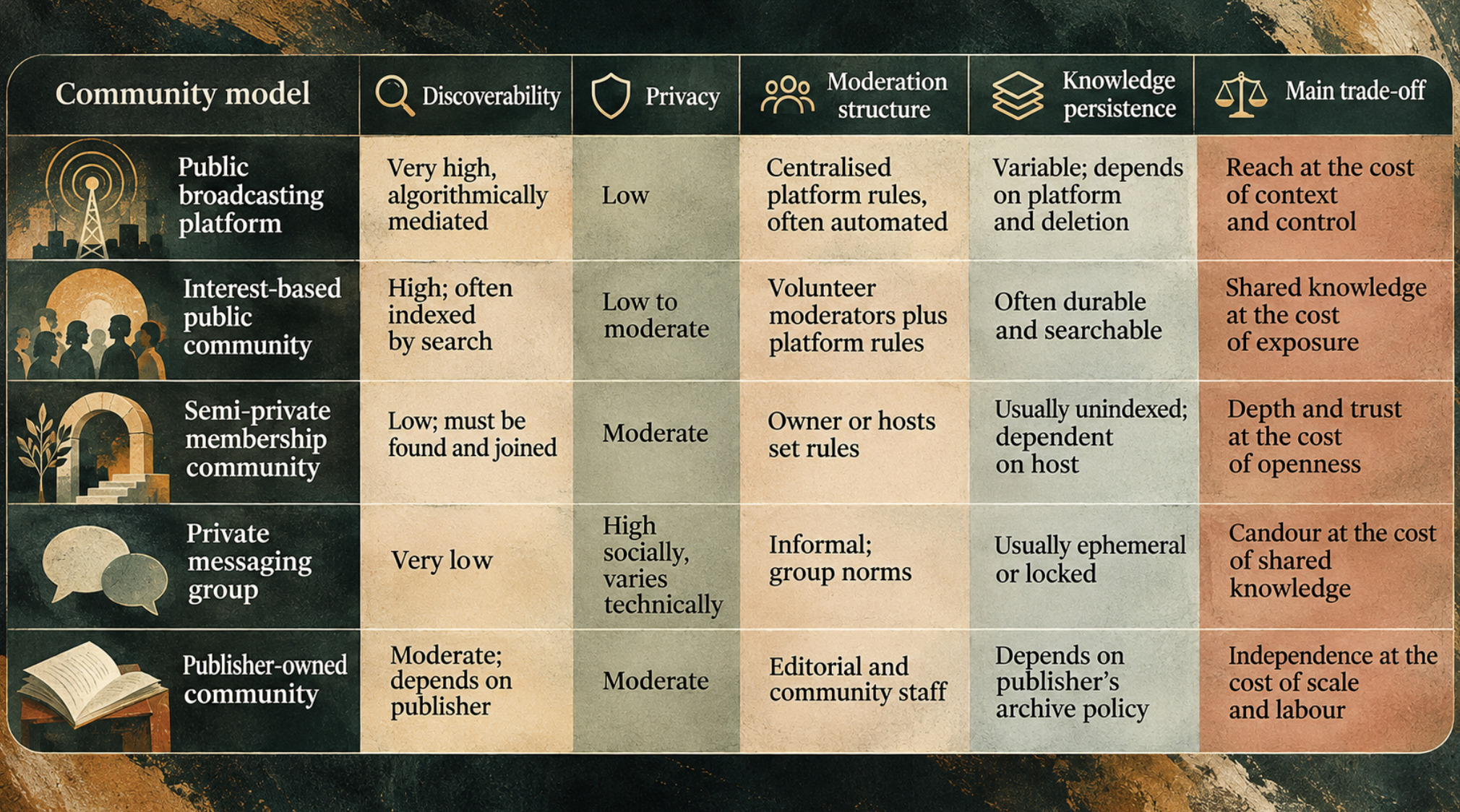
No model is ideal for every purpose. A medical support group needs privacy; a technical community benefits from public, searchable answers; a news organisation needs both reach and a deeper relationship with readers. The useful question is not whether a space is public or private, but whether its structure fits the kind of conversation it is meant to host — and what is lost to everyone else when it does not.
What this means for independent publishers
For journalism and independent media, the shift towards private sharing is a mixed development. On one hand, it weakens the public referral channels on which many publishers built their audiences: if readers discover a story on a public platform but discuss it in a group chat, the publisher sees neither the conversation nor, often, the reader. Traffic from social platforms has become volatile for many publishers, and the discussion that does happen is largely invisible to them.
On the other hand, the same shift has encouraged publishers to invest in direct relationships — email newsletters, memberships, events, reader communities — that do not depend on platform distribution. Newsletters, in particular, occupy a hybrid position: they arrive privately in an inbox but are often published openly on the web, combining personal delivery with public discoverability. Membership models can strengthen editorial independence, because revenue comes from readers rather than advertising mediated by platforms.
The tension is that the public interest mission of journalism depends on being discoverable by people who are not already readers. A publisher that retreats entirely into private communities may become more financially stable but less publicly consequential. The more durable strategy appears to involve both: public content that can be found, cited and shared, and deeper community relationships that give readers a reason to stay. The balance will differ by publication, but neither half is optional.
A more fragmented internet — but not necessarily a closed one
What happens next is uncertain, and it is worth separating what is already happening from what is merely possible.
Already happening: personal sharing on major platforms has moved substantially into messaging; recommendation-driven feeds increasingly dominate public platforms; creators and publishers are building subscription and membership businesses; and open protocols such as ActivityPub and the AT Protocol support networks in which users can, to varying degrees, move between servers and applications.
Possible but unproven: that interoperability between platforms will become widespread enough to let communities move without losing their relationships; that community portability will extend beyond individual accounts to groups and their histories; that new tools will make it practical to archive or selectively publish valuable knowledge from private spaces with members' consent; and that digital identity will become less tied to any single platform. Regulatory developments, such as the European Union's interoperability obligations for large messaging services under the Digital Markets Act, push in some of these directions, but their practical effects remain limited so far.
It is also possible that fragmentation deepens: more conversation in closed spaces, more public content generated by machines and professionals, and a public web that becomes less representative of what people actually think. None of these outcomes is inevitable. They will depend on platform design, regulation, the choices of communities and publishers, and the willingness of users to maintain public spaces worth participating in.
The internet is not simply becoming private
Return to the hospital investigation. The newspaper's public post did what public posts now do well: it made the story findable, citable and shareable. The group chats, the parents' forum and the researchers' community did what smaller spaces do well: they gave people somewhere to react honestly, among those they trusted, with the context only insiders could supply. Neither space did the other's job.
The evidence does not show that the internet as a whole is becoming private. It shows something narrower and more interesting: that ordinary people's personal sharing has moved substantially from public feeds into messages and groups, while public platforms have become more dominated by professional content and algorithmic recommendation. Public and private communication are diverging in function rather than one replacing the other.
That divergence carries costs that deserve more attention than they receive. When valuable knowledge and candid debate happen only in closed spaces, the public loses access to them; journalists, researchers and future historians lose evidence; and communities lose the ability to learn from strangers who faced the same questions. At the same time, a public sphere built on context collapse and engagement incentives has not served people well enough to deserve uncritical defence.
A healthy digital environment needs both: spaces for intimacy and trust, and spaces for accessible knowledge, accountability and discovery — with clearer choices about what belongs where. The question is not whether to be public or private, but how to build an internet in which both kinds of conversation can flourish without one quietly consuming the other.