
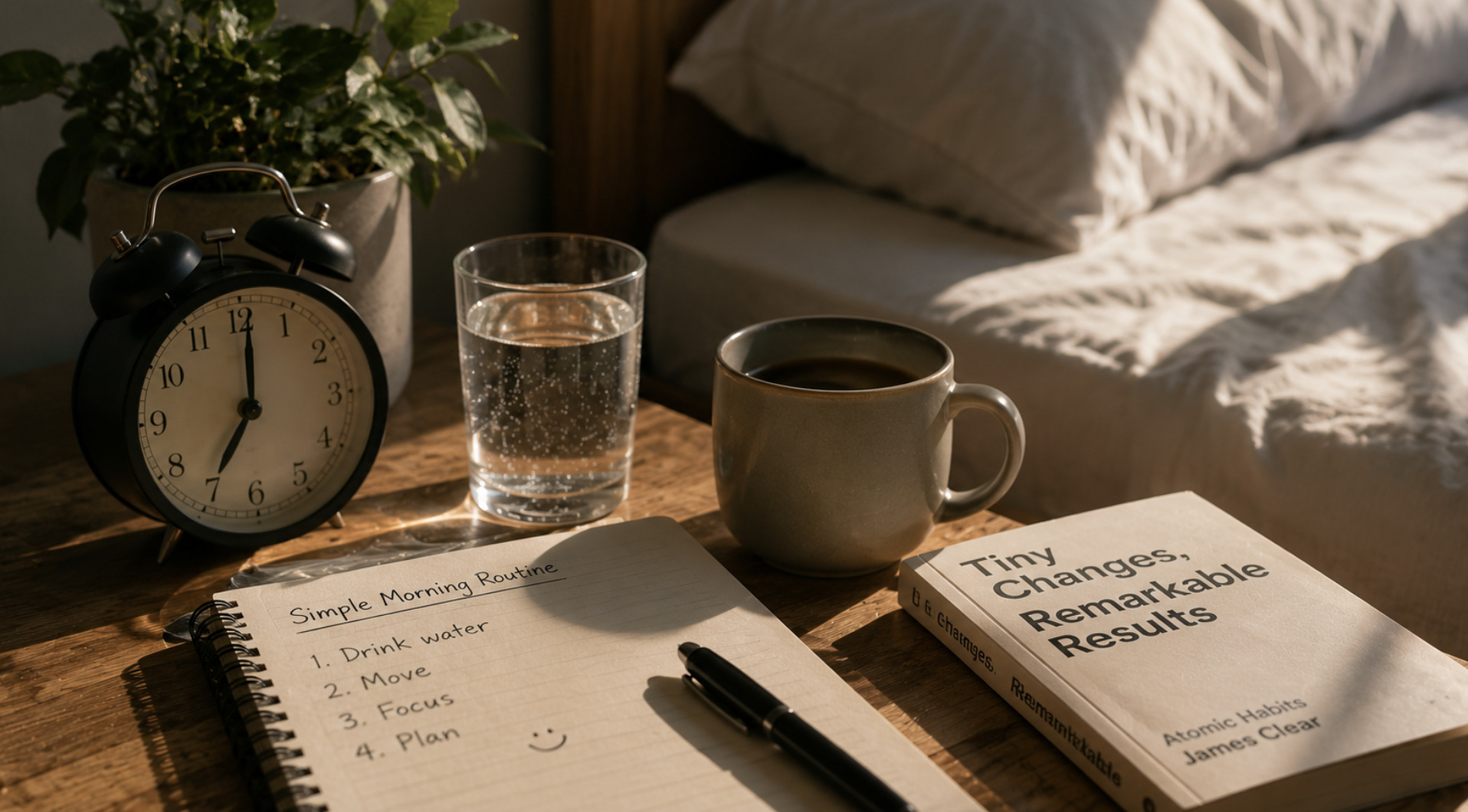
Building a Morning Routine That Actually Sticks
Search for advice on morning routines and you will drown in the same intimidating template: wake at five, meditate, journal, exercise, cold shower, read, plan t...

Community Author · July 20, 2026
Search for advice on morning routines and you will drown in the same intimidating template: wake at five, meditate, journal, exercise, cold shower, read, plan the day — all before most people have opened their eyes. It looks impressive and it almost always fails, because it asks for a complete personality transplant overnight and relies on willpower that runs out within a week. The truth about morning routines is quieter and more useful: the routines that last are small, realistic and built the way habits are actually formed. If you have tried and abandoned an elaborate morning ritual before, the problem was probably not you. It was the plan. Here is how to build one that actually sticks.
Why most morning routines fail
The first step to a routine that lasts is understanding why the ambitious ones collapse, because the failure is predictable. Most morning routines are designed in a burst of motivation, and motivation is a terrible foundation for anything that has to happen every day. On the morning you feel inspired, a six-step routine is easy. On the morning you slept badly, feel low, or simply do not want to, that same routine requires a heroic act of willpower — and willpower is a limited, unreliable resource that is often at its lowest first thing. A routine that depends on feeling motivated is a routine designed to fail on exactly the days you need it most.
The second reason is scale. People consistently try to change too much at once, stacking five new behaviours on top of a morning that previously contained none. Each new habit is a small act of resistance, and asking yourself to overcome five at once, every day, is a losing battle. The routine feels like a burden almost immediately, the burden breeds avoidance, and within a couple of weeks the whole thing quietly disappears. Understanding this is oddly freeing: the failure of past routines was not a personal weakness but a design flaw, and design flaws can be fixed. The solution is to work with how habits actually form rather than against it.
Start absurdly small
The single most important principle for a routine that sticks is to start smaller than feels worthwhile — almost embarrassingly small. Instead of committing to thirty minutes of exercise, commit to two. Instead of a long meditation, one minute. Instead of writing pages, a single sentence. This feels like it cannot possibly matter, and that reaction is exactly why it works. A tiny habit is easy to do on your worst morning, which means you actually do it, and doing it consistently is the entire point. Consistency, not intensity, is what turns a behaviour into a routine.
There is real psychology behind this. A habit forms through repetition, and repetition only happens if the behaviour is easy enough to survive low-energy, low-motivation days. A two-minute habit you do every morning for a month becomes automatic; a thirty-minute habit you do three times and abandon never gets the chance. Once a small habit is genuinely established — once it happens without a fight — you can let it grow naturally, and it usually does, because two minutes of exercise often becomes ten simply because you have already started. The goal at the beginning is not to accomplish much. It is to show up, every day, until showing up is automatic. This same principle of the quiet, unglamorous upgrade applies across wellbeing, as with the underrated power of rest we covered in better sleep is the quiet upgrade most people keep ignoring.

Anchor new habits to old ones
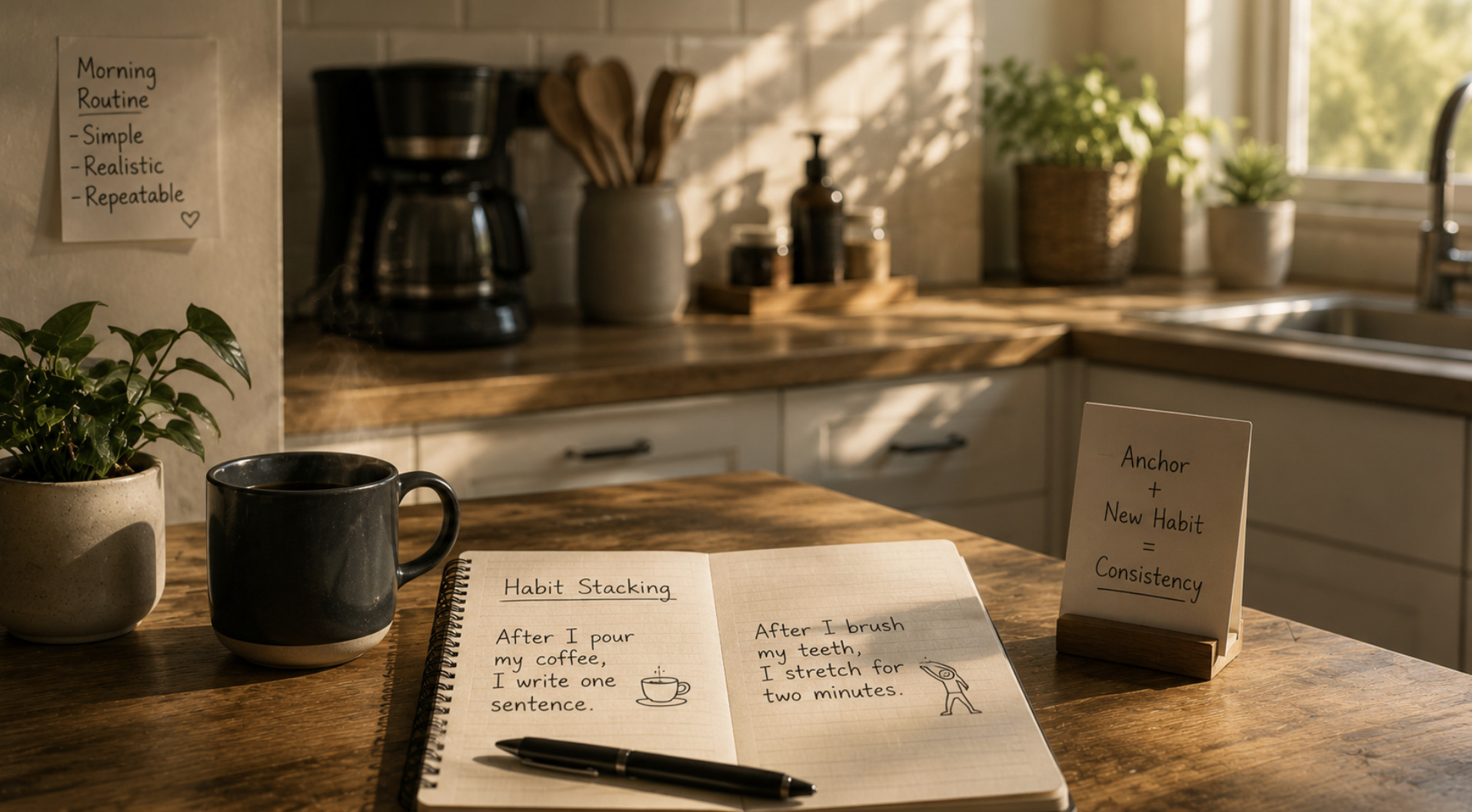
Small is the first half of the formula; the second is placement. New habits are far more likely to stick when they are attached to something you already do without thinking. Your morning is already full of automatic behaviours — making coffee, brushing your teeth, feeding a pet — and these existing anchors are the perfect scaffolding for new ones. Rather than trying to insert a habit into a vague slot called "the morning," attach it directly to an anchor: after I pour my coffee, I write one sentence; after I brush my teeth, I stretch for two minutes. The established habit becomes the reliable trigger for the new one.
This technique works because it removes the hardest part of a new habit, which is remembering and deciding to do it. When a behaviour is chained to something automatic, you no longer have to summon the intention each morning; the anchor does the reminding for you. Over time the new habit fuses to the old one and becomes just as automatic. Building a routine this way — as a short chain of small habits, each anchored to the last — is far more durable than trying to follow a schedule by force of will. You are not fighting your morning; you are quietly building on top of the parts of it that already run themselves.
Make it yours, and forgive the misses
A routine that sticks also has to be one you actually want, which means resisting the temptation to copy someone else's. The perfect morning routine is not the one a famous person swears by; it is the one that fits your life, your goals and your temperament. If you hate cold showers, do not build your morning around one. If quiet reading settles you more than exercise, start there. A routine assembled from borrowed habits you dislike will always feel like a chore, and chores get abandoned. The habits most likely to last are the ones that give you something you genuinely value, whether that is calm, energy, focus or a small sense of accomplishment before the day makes its demands.
Finally, build in forgiveness, because the thing that actually kills most routines is not a missed morning but the guilt that follows it. You will miss days; everyone does. The people who keep their routines are not the ones who never slip but the ones who simply start again the next morning without treating one lapse as proof of failure. A single missed day changes nothing; it is the spiral of "I've already broken it, so why bother" that does the damage. Treat your routine as something you return to rather than something you either perform perfectly or abandon, and it becomes remarkably resilient. A morning routine that sticks is not built from discipline and dramatic mornings. It is built from small habits, sensible anchors, genuine personal fit and the quiet willingness to begin again — and that is something almost anyone can sustain.
Frequently asked questions
How long does it take to build a morning routine? It varies by person and habit, but the key is consistency over intensity. Small habits repeated daily tend to become automatic over a few weeks. The more important factor is not a fixed number of days but doing the habit often enough, and keeping it small enough, that you rarely skip it.
What should a good morning routine include? There is no universal list. A routine that sticks is built from a few small habits that give you something you actually value — calm, energy, focus or a sense of accomplishment. Copying an elaborate routine from someone else usually fails; choosing one or two small habits that fit your life works far better.
Why do I always give up on my morning routine? Almost always because it was too ambitious. Routines built on willpower and multiple new habits at once collapse when motivation dips. Starting absurdly small, anchoring new habits to existing ones, and forgiving missed days instead of quitting after a slip are what turn a routine into something durable.