
Why Passkeys Are Quietly Replacing Your Passwords
If you have logged into an account recently and been offered the chance to sign in with your face, your fingerprint, or a tap instead of typing a password, you ...
Community Author · July 24, 2026
If you have logged into an account recently and been offered the chance to sign in with your face, your fingerprint, or a tap instead of typing a password, you have already met the technology that is slowly ending the password era. It is called a passkey, and it represents the most significant change to how we prove who we are online in decades. The shift is happening quietly, one login prompt at a time, but it is real and it is worth understanding — because passkeys are not just more convenient than passwords, they are fundamentally more secure, and they fix a problem the internet has struggled with since it began.
The problem passwords could never solve
To appreciate why passkeys matter, it helps to be honest about how badly passwords work. The password was built on a simple idea: a shared secret that you and a service both know, which you type to prove your identity. The trouble is that a shared secret is only safe if it stays secret on both ends, and in practice it rarely does. You have to remember it, which pushes people toward simple, reusable passwords. The service has to store it, which makes its servers a target. And it can be phished — tricked out of you by a fake login page — because anything you can type into the real site, you can be fooled into typing into a fake one.
The result is the security mess everyone knows too well: reused passwords, endless breaches, and phishing that remains devastatingly effective no matter how many warnings people receive. Decades of advice to "use a strong, unique password for every account" fought human nature and mostly lost. The fundamental flaw was never that people chose bad passwords; it was that the shared-secret model is brittle by design. Passkeys matter because they abandon that model entirely.
What a passkey actually is
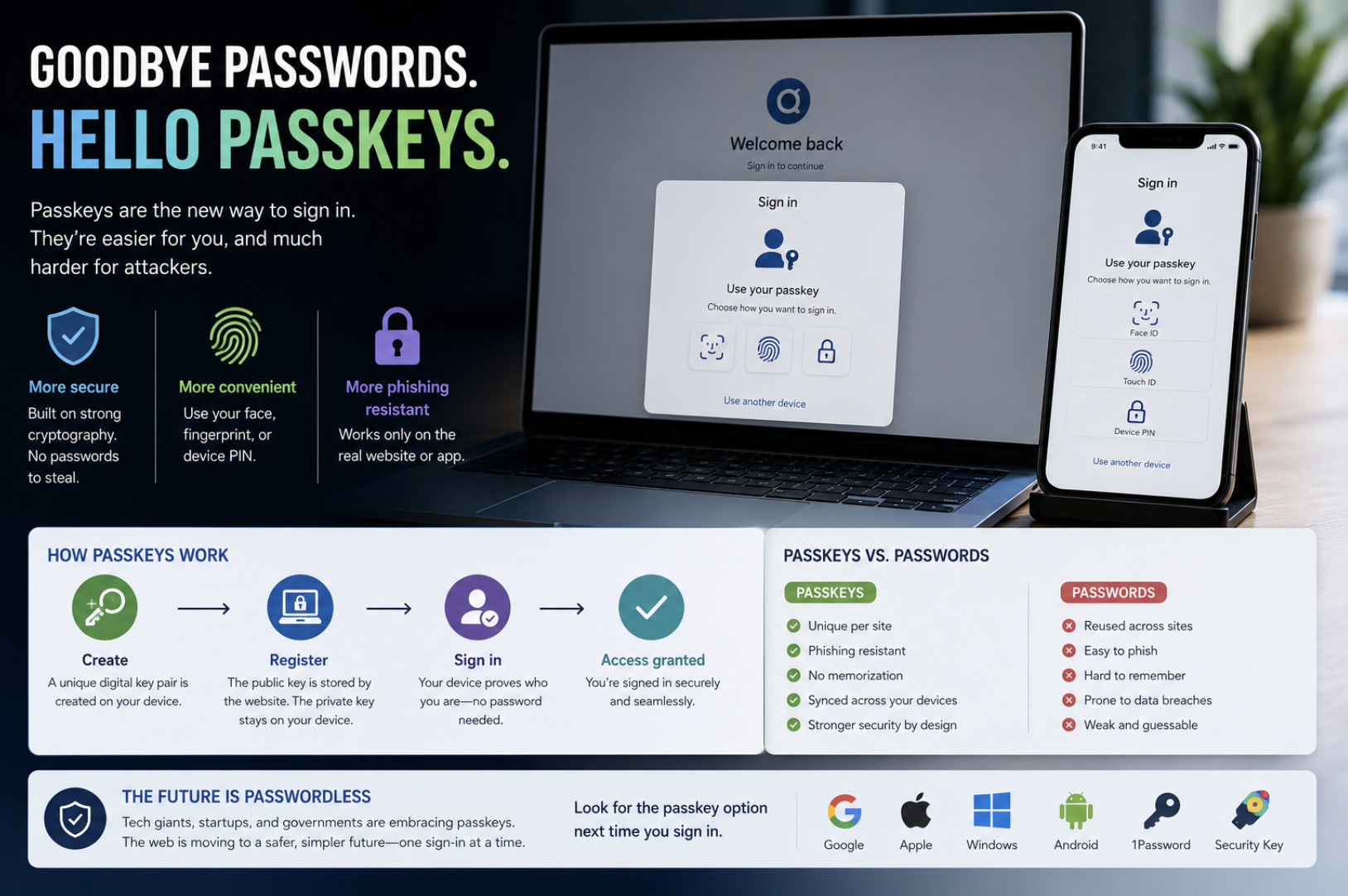
A passkey replaces the shared secret with something cleverer: a pair of mathematically linked keys, one private and one public. When you create a passkey for a service, your device generates this pair. The public key is handed to the service and stored there; the private key never leaves your device. Logging in works by your device using the private key to answer a challenge from the service in a way that only the matching public key can verify — proving you hold the private key without ever revealing it.
The consequences of that design are where the magic lives. Because the private key never leaves your device and is never sent anywhere, there is no secret for a service to store insecurely and no secret to steal in a breach — a stolen public key is useless on its own. And because logging in requires the physical device holding the private key, unlocked by your fingerprint, face or PIN, there is nothing for you to type and therefore nothing to be tricked into typing on a fake site. The passkey is bound to the real service and simply will not work on an impostor one. In practice, you experience all of this as nothing more than a fingerprint or a glance.
Why passkeys beat passwords
Line the two up and the improvement is not incremental, it is categorical. Passkeys are essentially immune to the attacks that make passwords such a liability. Phishing, the single most effective way accounts are compromised, largely stops working, because there is no secret to hand over and the passkey refuses to authenticate to a fraudulent site. Mass breaches lose most of their power, because the servers no longer hold anything that can be used to log in as you. And credential stuffing — reusing passwords leaked from one site to break into others — becomes pointless when there are no reusable passwords to leak.
There is a quieter benefit that matters just as much day to day: passkeys are easier. There is nothing to remember, nothing to type, nothing to reset. You unlock your account the same way you unlock your phone, and the strongest option becomes the most convenient one — a rare alignment in security, where the safe path is usually the annoying one. This is part of a broader move toward technology that removes friction rather than adding it, a theme we explored from a different angle in the end of the search box.
Living with passkeys
None of this means the transition is instant or without wrinkles, and it is fair to name them. We are in a hybrid period where not every service supports passkeys yet, so passwords will linger for a while and you will use both. A reasonable question people ask is what happens if you lose your device — and the answer is that passkeys are designed to sync securely across your devices through your accounts, so losing one phone does not lock you out, though it is worth understanding how your particular setup handles backup and recovery before you rely on it.
The practical advice is simply to say yes. When a service you use offers to set up a passkey, take it, especially for important accounts like email and banking where the security gain is largest. You lose nothing by adding one — the password usually remains as a fallback during the transition — and you gain protection against the exact attacks that cause most account compromises. The password is not going to vanish overnight, but its long, troubled reign is finally ending, replaced by something that is both safer and simpler. That is a rare and welcome thing in technology, and it is arriving quietly at a login prompt near you.
Frequently asked questions
What is a passkey? A passkey is a modern replacement for a password that uses a pair of mathematically linked keys. Your device keeps a private key that never leaves it, while the service stores a matching public key. You log in by unlocking your device with a fingerprint, face or PIN, with nothing to type or remember.
Are passkeys more secure than passwords? Yes, substantially. Because the private key never leaves your device and nothing is typed, passkeys resist phishing, are useless to steal in a data breach, and eliminate password reuse attacks — the very methods behind most account compromises. They are more secure and more convenient at the same time.
What happens if I lose my device with a passkey? Passkeys are designed to sync securely across your devices through your accounts, so losing one device generally does not lock you out — you can still sign in from another. It's worth checking how your specific setup handles backup and recovery before relying on it as your only login method.