
Why AI Agents Are Quietly Becoming the Next Big Tech Shift
For the last few years, the face of artificial intelligence has been the chatbot: you ask, it answers. It writes your email, summarises your document, explains ...
Community Author · July 14, 2026
For the last few years, the face of artificial intelligence has been the chatbot: you ask, it answers. It writes your email, summarises your document, explains a concept, and then stops, waiting for the next instruction. Useful, but passive. The quiet shift now reshaping the field is the move from AI that answers to AI that acts — from chatbots to agents. An AI agent does not just tell you what to do; it goes and does it, carrying out multi-step tasks with limited supervision. It is the difference between a tool you operate and an assistant you delegate to, and it may turn out to be the most consequential change in how people use computers since the arrival of the smartphone. Understanding what agents are, and being honest about what they can and cannot yet do, is worth doing now, before the hype outruns the reality.
From answering to doing
The clearest way to grasp an AI agent is to compare it with the chatbot everyone already knows. A chatbot is fundamentally reactive: it produces a response to a prompt and then waits. If you want it to accomplish something involving several steps, you have to walk it through each one, feeding it instructions and stitching the pieces together yourself. The intelligence is real, but the initiative is entirely yours. You are the one holding the plan; the chatbot just fills in the parts you ask for.
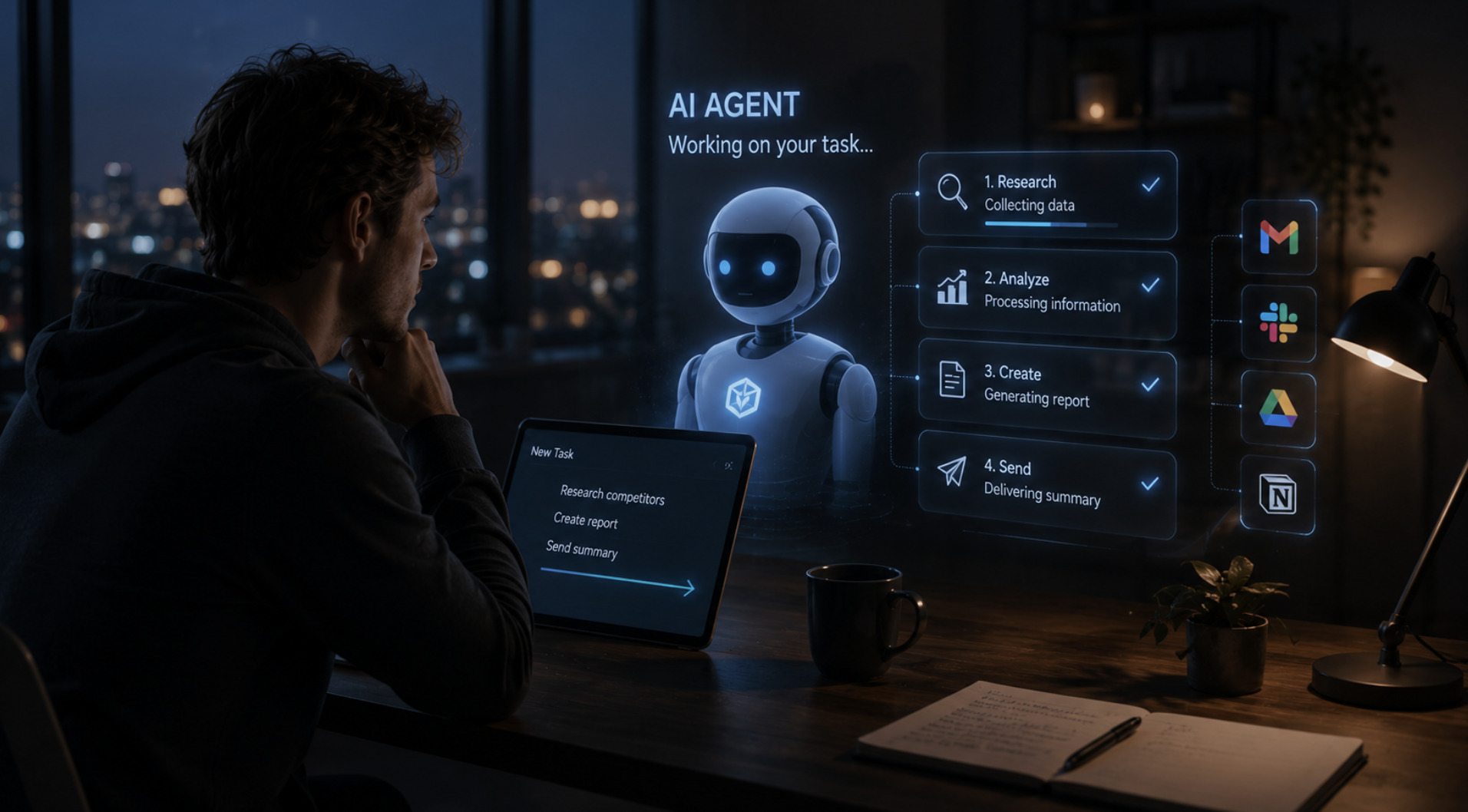
An agent flips that relationship. Given a goal rather than a single instruction, an agent can break the goal into steps, decide what to do first, take actions, observe the results, and adjust — looping through this cycle until the task is done. Crucially, agents can use tools: they can browse the web, run software, fill in forms, call other services and manipulate files, rather than only generating text. That ability to take actions in the world, not just describe them, is what separates an agent from a chatbot. You hand it a destination; it works out and walks the route. This is the leap that has the technology industry paying close attention, and it builds directly on the shift away from the old search box we described in what we will lose when asking becomes conversation.
Where agents already earn their keep
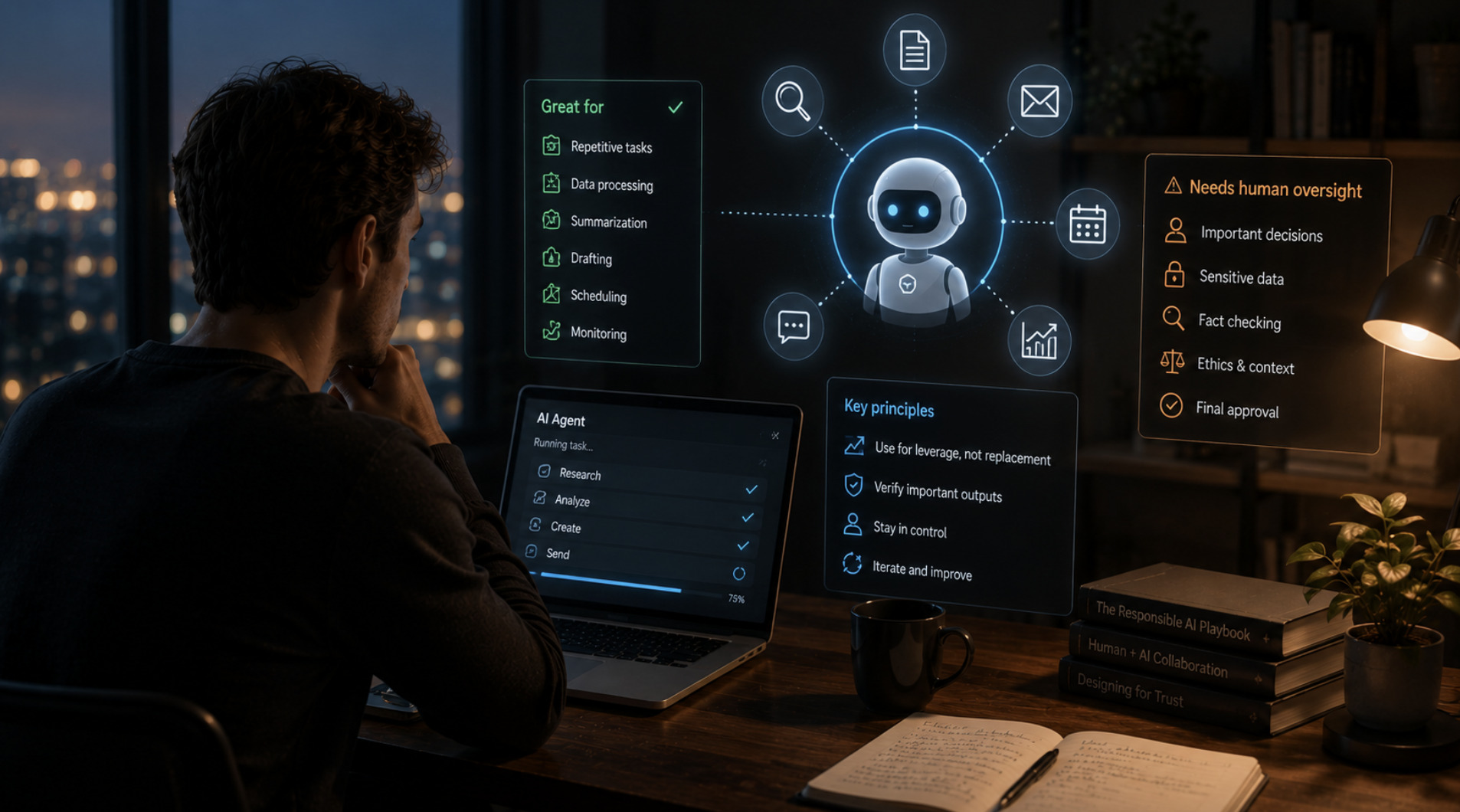
This is not purely a future promise; agents are already doing real work, especially where a task is well-defined and repetitive. Software development has been an early proving ground: agents can take a coding request, write the code, test it, notice errors and fix them across several steps, compressing work that used to require constant human back-and-forth. Research and data tasks are another natural fit, where an agent can gather information from many sources, cross-check it and assemble a summary without a person guiding every click. Anywhere a job consists of a clear goal reached through a series of tedious, rule-bound steps, agents are beginning to take over the grind.
Customer support, personal admin, and workflow automation are following the same path. An agent can, in principle, read a request, look up the relevant information, take the necessary action and report back — handling the whole loop rather than just drafting a reply for a human to send. The common thread is delegation of process: instead of using AI to help you do a task faster, you increasingly hand the task over and check the result. For repetitive digital work, this is a meaningful change in how much a single person can get done, and it is why so many companies are racing to build agents into their products. The direction of travel is unmistakable, even if the destination is still some way off.
The limits that separate hype from reality
For all the excitement, an honest look at agents has to be clear about how far they still have to go, because the gap between a slick demo and dependable everyday use is wide. The core challenge is reliability. An agent that takes many steps can go wrong at any one of them, and errors compound: a small mistake early in a task can send everything that follows in the wrong direction. A chatbot that produces a flawed paragraph is a minor annoyance; an agent that takes a wrong action several steps deep into a real task can create a genuine mess. Trusting a system to act on your behalf demands a level of consistency that the technology is still working toward.
This is exactly why the question of supervision matters so much. The more autonomy an agent has, the more important it becomes to know when it should pause and ask, and when it can be trusted to proceed — particularly for anything consequential, like spending money, sending messages or changing important data. The same fluency that makes these systems impressive can also make them confidently wrong, a limitation that runs through all current AI and that we have written about in the context of why AI tools can make creativity feel faster and emptier. Sensible use of agents today means keeping a human in the loop for anything that matters, treating the agent as a capable but fallible assistant rather than an infallible one. The technology is powerful and improving quickly, but it is not yet something to hand the keys to unwatched.
Why this shift matters for everyone
Even with those caveats, the move from answering to acting is a big deal, because it changes the fundamental relationship between people and computers. For decades, we have operated our machines step by step, clicking and typing our way through every task. Agents point toward a different model, one where we describe what we want and the computer figures out how to get there. If that model matures, it could reshape work and daily life as profoundly as the graphical interface or the smartphone did, quietly removing huge amounts of the tedious digital labour that fills modern days.
The right posture, as with any powerful new technology, is neither breathless hype nor dismissal. AI agents are real, they already do useful work, and they are getting better fast — but they are also unreliable in ways that demand caution, and they are not the finished, autonomous helpers the flashiest demonstrations imply. The people who benefit most from this shift will be the ones who understand both sides: who use agents to offload the repetitive work they are genuinely good at, while keeping a careful hand on the wheel for everything that matters. The chatbot taught us that computers could talk. The agent is teaching them to act — and that, handled wisely, is a change worth paying attention to.
Frequently asked questions
What is the difference between an AI agent and a chatbot? A chatbot responds to prompts and waits; it produces text but does not act. An AI agent is given a goal and can plan, take multiple steps, use tools like web browsers and software, observe results and adjust until the task is done. In short, a chatbot answers, an agent acts.
Are AI agents safe to use for important tasks? They can be useful, but reliability is still a real limitation, and errors can compound across steps. For anything consequential — spending money, sending messages, changing important data — it is wise to keep a human in the loop and treat the agent as a capable but fallible assistant rather than a fully trusted one.
What can AI agents actually do today? They are already handling well-defined, repetitive digital tasks: writing and testing code, gathering and summarising research, and automating multi-step workflows in areas like support and admin. They work best where a clear goal is reached through a predictable series of steps, and less well where judgement and high reliability are essential.