

Why Beautiful Environments Change Human Behaviour
Consider a single financial decision — say, whether to commit a substantial sum to an opportunity offered by a colleague. Now imagine making that decision in tw...
Community Author · May 29, 2026
Consider a single financial decision — say, whether to commit a substantial sum to an opportunity offered by a colleague. Now imagine making that decision in two different settings. In the first, you and your colleague are sitting at a folding table in a fluorescent-lit conference room with stained carpet and a humming air conditioner. In the second, you are at a corner table at a Michelin-starred restaurant overlooking a harbour, with attentive service, warm low light, the smell of citrus and roast lamb, and a glass of cold wine in your hand. The financial proposition is identical in both cases. Your decision, almost certainly, would not be.
This intuition has been one of the more durably investigated findings in cognitive science and environmental psychology over the past half-century. The setting in which a decision is made is not a neutral backdrop; it is a constitutive part of the decision itself. The brain that judges, evaluates risk, weighs costs and benefits is doing so in continuous dialogue with the room it occupies — with its proportions, its light, its temperature, its acoustics, its scent. Change the room and you change, measurably, the output of the brain inside it. What follows is a short tour of what the research has established, and what its implications are for how we ought to think about the spaces we move through.
The unconscious architecture of judgment
The serious study of how built environments affect cognition began in earnest in the late 1960s, when the psychologist Robert Sommer documented that hospital patients in differently arranged dayrooms behaved differently — more conversation in one configuration, more withdrawal in another — even though the patients themselves were unaware that the furniture had been moved. Sommer's work, gathered in his 1969 book Personal Space, established a methodological principle that has organised the field since: people are reliably affected by environmental variables that they cannot, when asked, identify as causes of their behaviour.
The landmark application of this principle came in 1984, when the environmental researcher Roger Ulrich published a paper in the journal Science titled "View Through a Window May Influence Recovery from Surgery". Ulrich examined records of patients recovering from cholecystectomy in a Pennsylvania hospital. Half had been assigned to rooms whose windows faced a small grove of trees; the other half to identical rooms whose windows faced a brick wall. The two groups, comparable on every other clinical measure, differed significantly. Patients with a view of the trees recovered faster, required fewer doses of painkillers, and had shorter hospital stays. The paper became one of the most cited in environmental psychology, and its central claim — that aesthetic and natural elements of an environment have measurable effects on human physiology — has been replicated and extended many times since.
The Ulrich finding is worth dwelling on because of what it implies. Beauty, in the sense of an environment that incorporates natural light, organic materials, and visual access to plants or sky, is not merely a pleasant addition to a functional space. It is a measurable biological input. The body recovers faster in beautiful rooms than in ugly ones — not because of any conscious preference, but because the nervous system responds differently to the two environments. Aesthetics, on this picture, is a branch of medicine rather than a branch of decoration.
What specific variables actually do
The decades since have produced a granular literature on which architectural variables produce which behavioural effects. Three findings have particular force.
The first concerns ceiling height. A 2007 study by Joan Meyers-Levy at the University of Minnesota, published in the Journal of Consumer Research, found that participants asked to perform cognitive tasks in rooms with ten-foot ceilings tended toward more abstract, creative, and integrative thinking than participants in rooms with eight-foot ceilings, who tended toward more concrete, detail-oriented analysis. The effect was robust across multiple experiments. The hypothesis is that the body's sense of physical openness translates into a corresponding cognitive openness — the brain, in some sense, mimics the proportions of the room it is inside.
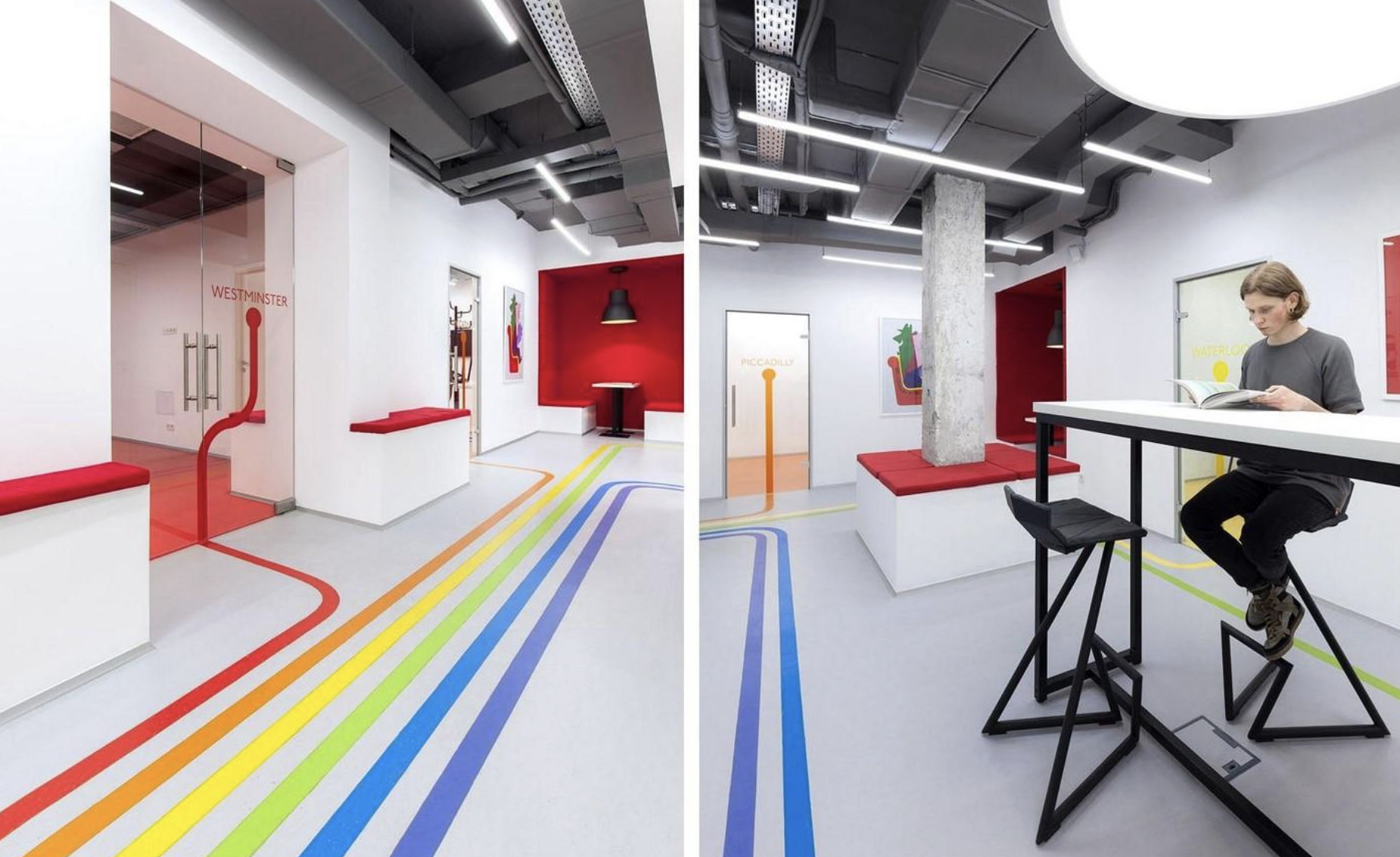
The second concerns colour and lighting. Red environments are reliably arousing; they raise heart rate slightly and produce a sense of urgency. Blue environments are calming. Warm, dim lighting reduces the perception of time passing, which is why restaurants designed to encourage lingering use low-wattage incandescent bulbs while fast-food chains use bright cool lighting that subliminally signals "this is not a place to stay". The colour of a room is information that the body reads before the mind notices it has been read.
The third concerns scent. A 1995 study conducted by the neurologist Alan Hirsch at the Las Vegas Hilton found that introducing a pleasant ambient fragrance into a section of the casino floor increased the time players spent at slot machines, and the amount they wagered, by a substantial margin. The fragrance was not perceived as intrusive or even consciously noticed by most patrons; it was simply present, modifying behaviour through a sensory channel that operates below the threshold of attention. The casino industry took the finding seriously, and proprietary ambient fragrances are now standard features of nearly every major gaming floor.
The Friedman-Thomas debate
The most documented case study of environmental design as deliberate behavioural engineering is the divergence in casino architecture between two schools of thought that emerged in Las Vegas in the late twentieth century. The first, associated with the designer Bill Friedman, argued that casinos should be designed to maximise disorientation: low ceilings, no windows, no clocks, labyrinthine layouts, busy carpet patterns, intentionally confusing wayfinding. The goal was to keep patrons inside, distracted, and unaware of time. For roughly two decades, the Friedman school dominated American casino design.
In the late 1990s, the designer Roger Thomas, working principally for Steve Wynn's casino properties in Las Vegas, argued for the opposite. Thomas's casinos featured high ceilings, abundant natural light, expensive art, lush vegetation, refined finishes, and clear wayfinding. The thesis — sometimes called the "playground" theory — was that patrons who felt good would stay longer than patrons who felt disoriented, and that the beautiful environment would attract a wealthier clientele willing to wager more. The financial results vindicated Thomas. Within a decade his approach had reshaped casino architecture worldwide, and most major properties opened since 2005 follow it rather than the Friedman model.
The Friedman-Thomas debate is interesting beyond its industry context because it represents a rare case in which the same business problem was solved, with measurable economic outcomes, by two opposed environmental theories. Both schools were exploiting environmental psychology; they simply disagreed about whether disorientation or comfort was the more effective lever. The market verdict was for beauty — not because beauty is more ethical but because, on the available evidence, it is more lucrative.
Beauty and the alteration of risk
This brings the discussion to its most consequential finding. Beautiful environments do not merely affect mood and time spent. They alter risk perception in a specific and consistent direction. People in beautiful environments are more willing to take financial, social, and physical risks than the same people would be in ugly or neutral environments. The effect has been demonstrated in laboratory studies on investment decisions, in research on negotiation outcomes, and in observational data on consumer behaviour.
The mechanism appears to involve a downstream consequence of the well-being that beauty produces. When the body is calm and the senses are pleasantly engaged, the threat-detection circuits of the brain are correspondingly quieter; loss aversion, the asymmetric weighting of potential losses over potential gains that is one of the most robust findings in behavioural economics, is partially suppressed. The person feels safer than they actually are. Decisions that would have triggered caution in a fluorescent conference room slide through with relative ease in a candlelit dining room. The decision is not better or worse; it is structurally different, taken in a different cognitive state.
This is the part of the literature that bears most directly on the gambling industries, the luxury retail industries, and any commercial environment designed to facilitate large discretionary spending. The aesthetic apparatus of these spaces is not an aesthetic apparatus only; it is a behavioural intervention. The same brain placed in a different room makes different choices, and the difference is, in many of these settings, the operating margin.
The implications extend beyond physical architecture and into the design of contemporary digital environments. Online platforms cannot rely on marble, chandeliers, or ocean views, yet they pursue many of the same psychological objectives through interface design, visual coherence, animation, and atmosphere. A platform such as DicePalace operates within this broader tradition of aesthetic engineering, where the goal is not merely to make an environment attractive but to create a setting in which attention is sustained and decision-making feels effortless. The migration from physical luxury spaces to digital ones has changed the medium but not the underlying principle: environments that feel comfortable, elegant, and well-designed can subtly influence how people evaluate opportunities, weigh risks, and ultimately decide to spend their time and money. In this sense, aesthetics function not as decoration but as part of the architecture of choice itself.
The cathedral and the casino
It is worth noting that the same environmental toolkit can serve opposed purposes. The great medieval cathedrals of Europe used high ceilings, controlled natural light filtered through stained glass, music in the form of plainsong reverberating through stone vaults, and the deliberate scale of architecture vastly exceeding the human body to produce, in their visitors, a particular cognitive state — humility, awe, openness to the transcendent. Roger Thomas's casinos use a startling number of the same techniques to produce a different but adjacent state: well-being, expansiveness, willingness to engage with the activity on offer.
The techniques are not neutral, and they are not specific to either cathedral or casino. They are facts about how the human nervous system responds to large, beautiful, controlled environments. What changes is what the architects and operators of those environments want their visitors to do once the response has been activated. Cathedrals direct the response upward, toward worship; casinos direct it inward, toward the table. The toolkit is the same; the intention is different.
This observation generalises. Hospitals, schools, workplaces, public squares, courtrooms, museums all use the same fundamental techniques — light, scale, sound, colour, materials — to produce specific cognitive and behavioural outcomes in the people who pass through them. The differences between a good hospital ward and a bad one, between a classroom that supports learning and one that suppresses it, between a workplace that enables sustained attention and one that scatters it, are very rarely large changes in the abstract function of the space. They are differences in how the environmental variables are calibrated. The toolkit is universal. The skill lies in its application.
What follows
The deepest implication of the literature is one that runs against the model of the autonomous individual decision-maker that most modern institutions implicitly assume. The decision to invest, to trust, to take a risk, to commit, to leave — these are not produced by the mind acting on neutral inputs. They are produced by a coupled system of brain and room, in which the room is doing work that the brain does not register as work. The choice to design a room well is therefore, in a literal sense, the choice to design the decisions that will be made inside it.
For institutions that want their occupants to think clearly, recover quickly, learn deeply, or act ethically, the implication is that environment is not a secondary concern. It is a primary input. The hospital room, the schoolroom, the boardroom, the public space, the home — each is a cognitive instrument as much as a physical container. The science has long since established this. The harder question, the one our societies have only begun to ask seriously, is what we want the rooms to do — and what, in return, we should be willing to spend to make them do it well.