
When Robots Start Running Faster Than Us
There are moments when technological progress stops feeling abstract and becomes uncomfortably real. Not in laboratories, not in keynote presentations, but in p...
Community Author · April 23, 2026
There are moments when technological progress stops feeling abstract and becomes uncomfortably real. Not in laboratories, not in keynote presentations, but in places where human limits have always been clearly defined.
A marathon is one of those places.
For decades, it has stood as a symbol of endurance, discipline, and biological boundaries. The human body pushed to its edge, measured in time, distance, and willpower. But in April 2026, in Beijing, that symbolic boundary shifted—quietly, but irreversibly.
More than one hundred humanoid robots lined up alongside human runners. They didn’t come to demonstrate. They came to compete.
And some of them won.
A Race That Redefined the Field
Just a year earlier, the same experiment looked almost naïve.
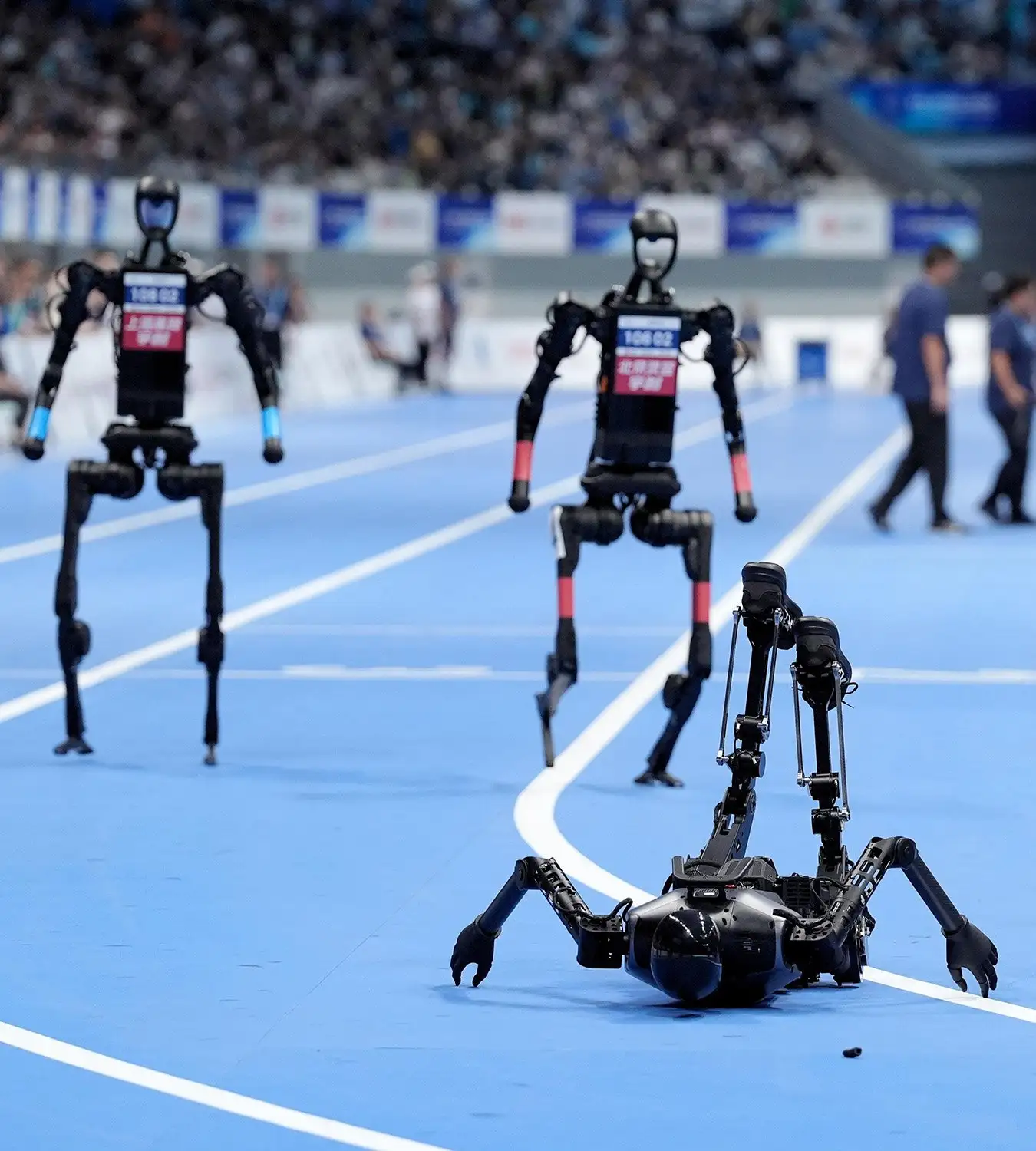
Robots struggled to even start. Many collapsed within minutes. Most never finished the race. The fastest among them crossed the line in 2 hours and 40 minutes—impressive for a machine, but nowhere near human performance.
It was easy, then, to dismiss the idea.
But twelve months in technology is no longer a small unit of time. It is an era.
In 2026, the number of participating androids increased dramatically—from around 20 to more than 100. Their movement was no longer experimental. It was controlled, stable, and, in some cases, remarkably fast.
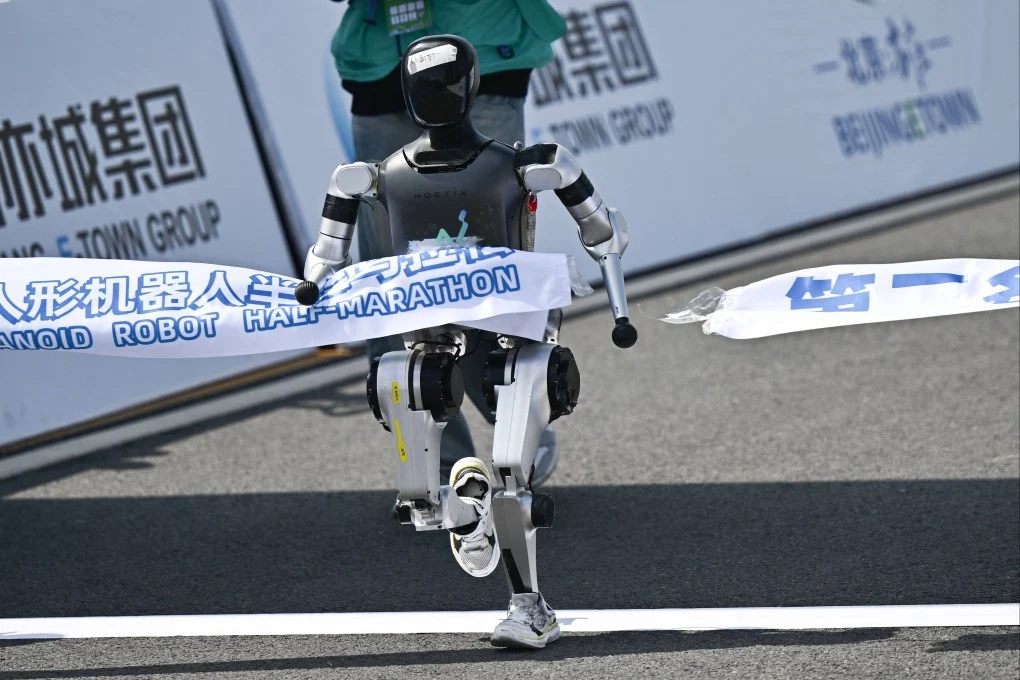
The winning robot, developed by the Chinese tech company Honor, completed the half marathon in 50 minutes and 26 seconds.
That time is not just competitive.
It is elite.
For context, it places the machine within a range that challenges serious human athletes—not world champions, but far beyond casual or even trained runners.
Yes, the robot needed assistance shortly before the finish line after colliding with a barrier. But that detail no longer defines the story.
The time does.
Not a Demonstration — A Direction
It would be easy to frame this as a spectacle. A clever display. A technological curiosity designed to capture headlines.
But that would be a mistake.
Because what happened in Beijing was not about sport. It was about capability.
Robots and humans ran on parallel tracks—not to protect the machines, but to avoid collisions. That detail matters. It signals a shift in positioning: these systems are no longer fragile prototypes. They are participants operating in real-world conditions.
The question is no longer can they move?
The question is where else can they go?
The Real Arena Is Not the Marathon
Running is not the goal.
It is the test.
Endurance, balance, coordination, energy efficiency, adaptability—these are not athletic qualities in this context. They are industrial ones.
A robot capable of maintaining speed over long distances, adjusting to terrain, recovering from instability, and continuing after impact is not just a runner.
It is a system ready for deployment.
And the implications extend far beyond sport:
hazardous environments where human presence is risky
disaster response zones
military logistics and operations
large-scale industrial infrastructure
The marathon is simply a controlled environment where these capabilities become visible.
China’s Strategic Acceleration
This progress is not happening in isolation.
China has made its ambitions explicit: to become a global leader in humanoid robotics and advanced automation. And unlike many regions where innovation remains fragmented, this push is coordinated—through funding, infrastructure, and national visibility.
The presence of humanoid robots in high-profile cultural events, including state television broadcasts such as the annual Spring Festival Gala, is not accidental. It is narrative-building.
At one such event, robots developed by Unitree Robotics performed synchronized martial arts routines using swords, staffs, and nunchaku—executed in close proximity to human performers.
The message is clear.
These machines are not prototypes.
They are becoming part of the cultural and technological identity of the country.
The Speed of the Shift
What makes this moment particularly striking is not just the achievement, but the rate of change.
In one year:
failure turned into stability
instability turned into coordination
coordination turned into competitive speed
This is not linear progress.
It is exponential refinement.
And unlike previous technological waves, this one operates in a domain that has always been deeply human: physical presence in the world.
Machines are no longer confined to screens, data, or automation pipelines. They are moving, adapting, and interacting in shared space.
The Psychological Threshold
There is a deeper layer to this story—quiet, almost imperceptible, but far more consequential than the race itself.
For decades, machine superiority felt safely contained. It lived in abstract domains—calculation, memory, pattern recognition—areas where human intuition rarely competes directly. These were invisible victories, happening somewhere beyond everyday perception, inside systems we use but do not feel.
Movement changes that entirely.
The moment a machine occupies physical space—running, adjusting its balance, recovering from instability—it crosses into a territory humans understand without translation. Not intellectually, but instinctively. We don’t need data to evaluate it. We see it. We recognize it. We measure it against ourselves in real time.
And that recognition alters the relationship.
The machine is no longer distant. It is no longer operating in a parallel, abstract layer. It is present, visible, and—most importantly—comparable.
That is where the shift truly begins.
Because once a machine enters human space in a way we can intuitively grasp, it stops being just a tool. It becomes a reference point.
And from that moment on, the question is no longer what it can do.
It is how it measures against us.
Not Replacement, But Reframing
It is important to resist simplistic narratives.
Robots are not “replacing” humans in marathons. That is not the point.
The real change is more structural.
Human activity is being redefined in relation to machine capability.
What was once exclusively human—endurance, coordination, physical adaptability—is now shared territory.
And when territory becomes shared, its meaning changes.
Running a marathon will always matter. But it will no longer mean the same thing in a world where machines can do it too.
The Quiet Transformation
The most profound technological changes rarely announce themselves loudly.
They appear first as experiments. Then as demonstrations. Then as anomalies.
And finally, as normality.
The Beijing half marathon sits somewhere between demonstration and normalization. It is not yet routine. But it is no longer surprising.
That transition is the real signal.
Because once something stops surprising us, it has already begun to integrate into reality.
What Comes Next
Running is not the milestone—it’s the proof of capability.
A system that can sustain motion, maintain balance, adapt to disruptions, and recover under stress is already operating beyond demonstration. It is functional. And once functionality is established, deployment follows.
Traversal becomes access.
Access becomes presence.
Presence becomes substitution.
Not everywhere—but precisely where efficiency, safety, or scale make human limits a constraint rather than an advantage.
This is not a projection. It is a trajectory already in motion.
A Different Kind of Finish Line
What remains is not the race, but the image.
A humanoid machine crossing a finish line—slightly unstable, not flawless, but undeniably capable.
And that is the threshold.
Because technological progress is never defined by perfection. It is defined by viability. By the moment something works well enough to matter.
That moment has already passed.
From here, improvement is not a question of if, but of how fast.
And the direction is no longer ambiguous.